

Why law firms can’t find legal talent
The legal market has stabilised. Demand is returning. Firms are again looking at growth, capacity and profitability. Yet the same problem keeps coming up in conversations with law firm leaders across Australia and New Zealand: why law firms can’t find legal talent. Or more precisely, the leading legal talent. The easy answer is to call it a legal talent shortage. The more commercial answer is that many firms are trying to hire from a narrow view of the market, using recruitment methods built for a very different time.
The Australian legal market data supports the pressure firms are feeling. The 2026 ALPMA Australian Legal Industry HR Issues and Salary Survey found that recruitment and retention remain the dominant HR challenge, with 44% of firms saying recruitment had become harder over the previous 12 months and 63% concerned it will be difficult to find the staff they need in 2026. At the same time, 75% of firms are likely to recruit solicitors or lawyers in the next 12 months, reinforcing that hiring pressure continues to be driven by fee-earning capability.
The recovery is real. But the hiring model is still broken. Understanding why law firms can’t find legal talent starts with understanding how the market has changed.
Why law firms can’t find legal talent in today’s market
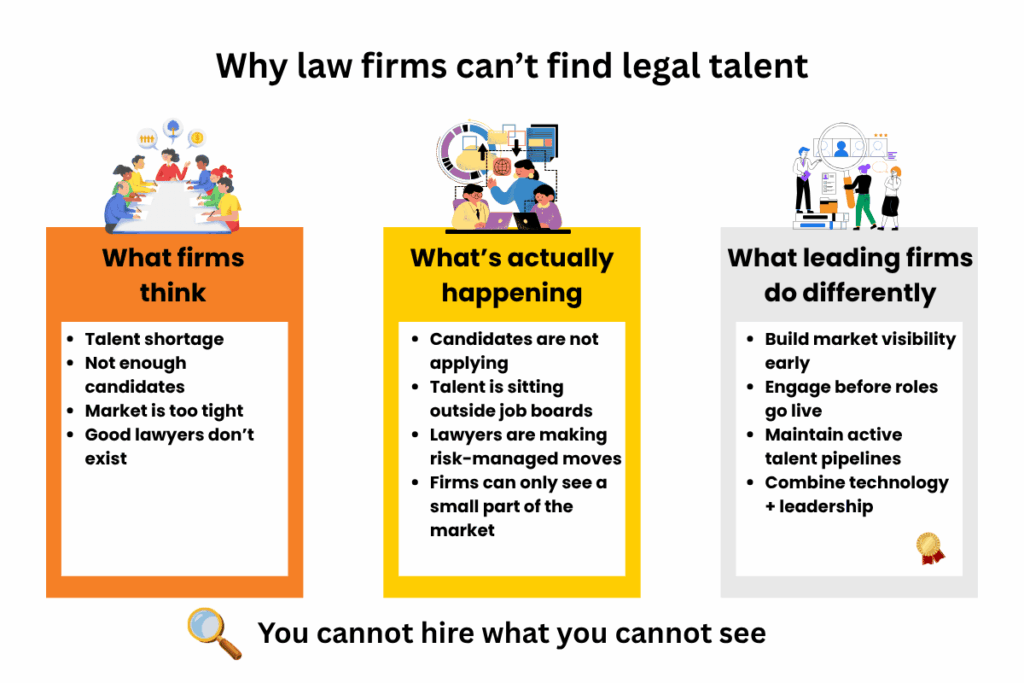
Most law firms describe the market as a legal talent shortage. There is some truth in that. The market is tighter, candidates are more selective, and certain practice areas remain difficult to hire into. But calling it a shortage can be misleading because it frames the problem as something external that firms simply have to endure.
The better question is this: are firms unable to find the talent they really want, and so they settle for a candidate they need? And is this simply because they have a narrow view of the talent market, are over-reliant on external recruitment agencies, or are they simply unable to see the full market?
In New Zealand, Insource data shows just under 2,000 lawyers currently sit in the critical 4 to 7 PQE private practice band. That is the cohort many firms describe as hardest to reach. Yet fewer than half have been in their current role for more than two years. Many are not actively applying to advertisements. Many are not sitting on traditional recruiters’ shortlists. But that does not mean they are unavailable. It means they are invisible to firms relying on the same hiring methods they have used for decades.
This means the best candidates are not always in the market in the traditional sense. They are not necessarily scrolling job boards, updating their CVs or speaking to recruiters. They are working, watching, comparing and waiting for the right opportunity to be presented in the right way.
The best candidates are not looking for roles. They are open to being approached and then to evaluating opportunities.
Why law firms can’t find legal talent through traditional channels
When firms say they cannot find lawyers, they often mean they cannot find lawyers through the channels they are already using. That is a very different problem.
Recently, when firms told the market there were not enough lawyers for a particular need, Insource tested that assumption. Within minutes, Insource Recruitment Technology identified more than 300 lawyers connected to the relevant region, including 87 in the exact PQE band that firms said they could not find. The talent existed. The visibility did not. That is the gap.
Most firms can see applicants. They can see candidates presented by recruiters. They can see people already active in the hiring market. What they often cannot see is the much larger group of lawyers who may be open to the right conversation, timing, or opportunity.
And in a market where candidates are cautious, that distinction matters even more. The ALPMA report describes the Australian legal recruitment market as stable, selective and salary-sensitive, with candidates increasingly prioritising stability, work-life balance, career progression and supportive culture. It also notes that active candidate pools are smaller and that job boards are not delivering, with more placements coming from targeted outreach, referrals, alumni networks and re-engaging passive talent.
That is a significant shift. It means the firms that are still waiting for the best candidates to apply are already too late.
The old recruitment model starts too late
Traditional legal recruitment generally begins when a role becomes urgent. A lawyer resigns. A practice group becomes overloaded. Growth creates a capacity gap. The firm writes a position description, speaks to recruiters, posts a role and waits.
The problem is that by the time the process starts, the firm has already reduced its options.
Urgency narrows thinking. It pushes firms towards whoever is available now, rather than who would be best. It increases reliance on external intermediaries. It often leads to inflated salaries, higher agency fees and longer periods of under-resourcing.
The ALPMA report shows why this matters commercially. Average salaries across the Australian legal sector increased by around 4.0%, ahead of national wage growth of 3.4%, showing that remuneration pressure remains elevated. It also found overall staff turnover stabilised at 23%, with turnover particularly high among paralegals and early-career roles.
At the same time, only 39% of firms increased headcount in the prior 12 months, while 65% expect to increase staff numbers in 2026. That gap between intention and reality suggests many firms want to grow but are still struggling to convert hiring plans into actual capacity.
That is the cost of reactive hiring. It does not just slow recruitment. It slows growth.
What younger lawyers are actually looking for
The best young lawyers are not disengaged from the profession. They are not avoiding private practice altogether. Many still want high-quality work, strong supervision, good development and a firm they can see themselves growing with.
But they are much more selective about what they move for. The top candidates today want more than a salary figure and a position title. They want clarity. They want to understand the team, the work, the expectations, the flexibility, the progression pathway and the leadership environment. They want to know why the opportunity is better than staying where they are.
That is particularly important because many good candidates are not making a desperate move. They are making a risk-managed move. The ALPMA report’s market update notes that lawyers are prioritising certainty, including clear reporting structures, stable pipelines, explicit flexibility arrangements and a better understanding of workload realities.
This is where firms often fall short. They spend time crafting the job description but not enough time shaping the opportunity. They talk about culture but fail to demonstrate it during the hiring process. They say they want strong candidates but then take too long to respond, delay feedback or allow decision-making to drift across multiple partners.
Candidates notice that. A slow hiring process sends a message. So does an unclear one.
Why law firms can’t find legal talent: the real issue is not attraction, it is conversion.
Many firms are doing more to attract talent. They are investing in employer branding, graduate programmes, LinkedIn visibility, content, culture pieces and flexible work messaging. None of that is wrong. But attraction is not enough.
The real failure point is often conversion. A candidate is identified. Interest is created. A conversation starts. Then the process slows. Internal alignment takes too long. Feedback is delayed. A partner becomes unavailable. Another approval is needed. The candidate continues speaking to other firms and eventually accepts an offer elsewhere.
From the firm’s perspective, that looks like a competitive market. From the candidate’s perspective, it looks like a firm that was not ready to act.
That is why visibility alone is not enough. Firms also need the internal capability to move once the right person is identified.
Quick answers for law firm leaders
Why law firms can’t find legal talent: In many cases, firms are relying on a narrow view of the market. They are only seeing active candidates rather than the broader pool of lawyers who may be open to the right opportunity.
What is causing the legal talent shortage? The pressure is being driven by selective candidate behaviour, salary competition, turnover, replacement hiring, cautious movement and outdated recruitment methods that do not show firms the full market.
What are the best young lawyers looking for in a law firm? The best young lawyers are looking for quality work, clear career progression, credible leadership, flexibility, a supportive culture and confidence that the firm is organised and decisive during the recruitment process.
Where should law firms reach young legal talent? Law firms should not rely only on job boards or recruiter shortlists. Strong candidates are often reached through market mapping, targeted outreach, alumni networks, referrals, direct engagement and always-on talent pipelines.
What should law firms do less of when hiring? Law firms should do less reactive hiring, less waiting for applicants, fewer unnecessary interview stages and less assuming that strong candidates will wait while internal decisions drag on.
What should law firms do more of? Law firms should build talent visibility before vacancies become urgent, involve hiring partners earlier, strengthen internal recruitment capability and use technology to create a wider view of the market.
How leading law firms are hiring better talent
The firms that are hiring well are not necessarily the firms with the biggest brands or the largest recruitment budgets. They are the firms that know the market before they need to hire.
They know where the right people sit. They know what “good” looks like for their team. They have visibility across the talent pool, and they are not starting from zero when a vacancy appears.
This is the shift many firms still need to make. Recruitment can no longer be treated as a process that starts when someone resigns. It needs to become a continuous capability that sits inside the business.
That means building talent pipelines before roles exist. It means using technology to map the market properly. It means bringing recruitment capability in-house rather than outsourcing all visibility to third parties. It means involving leaders at the points where their involvement actually changes outcomes.
One of the clearest examples of this is leader-led recruitment. In one recent New Zealand example, a top-tier firm needed to hire into an urgent construction litigation role at the 3-4 PQE level. Market mapping identified the talent, but the decisive shift came when the hiring partner stepped into the process and connected directly with the identified candidates. The result was a successful hire, stronger market engagement and an estimated $35,000 to $40,000 saved in recruitment placement fees.
Market mapping created the opportunity. Leadership converted it.
Technology is being applied to the wrong problem
Law firms are investing heavily in technology. AI for research. Automation for drafting. Tools for compliance, productivity and document management. Much of that investment makes sense.
But many firms are still applying sophisticated technology to everything except one of the biggest constraints on growth: hiring. This helps explain why law firms can’t find legal talent even while investing heavily in AI, automation and operational systems.
Recruitment remains reactive in many firms. It remains dependent on old channels. It remains opaque, expensive and slow.
That is increasingly difficult to justify when the market is demanding more from fewer people. The ALPMA report shows fee earners increased their share of total headcount from 62% to 65%, while support structures tightened and the number of fee earners per non-fee earner increased significantly. It also notes that secretarial leverage shifted sharply, with the number of fee earners supported by each secretarial role rising from 4.46 to 5.44 in one year, consistent with increased adoption of AI and automation.
In plain terms, firms are getting leaner. That makes every hire more important.
When a key lawyer is missing, the pressure does not disappear. It moves to the existing team. That affects workload, retention, client service and revenue. Hiring failure is no longer just an HR problem. It is a capacity problem. It is a profitability problem.
Are firms hiring what they want or what they can see?
This is the real question.
Most firms know the type of lawyer they want. They know the level, practice area, experience and cultural fit they are looking for. But when the pressure is on, many end up hiring from what is immediately visible rather than what is actually available.
That is how compromise happens.
Ultimately, why law firms can’t find legal talent often comes down to visibility rather than availability. A firm starts with a clear view of the ideal hire, but because the visible market is narrow, the search becomes reactive. The firm waits for applicants. It waits for recruiter introductions. It compares a limited pool. Eventually, the firm hires the best available person from a partial view of the market.
Sometimes that works. Often it does not.
The better approach is to widen the view before the pressure hits.
If you can see the leading legal talent, you can hire them
The answer to why law firms can’t find legal talent is often simpler than many firms realise. Law firms are not necessarily hiring the wrong people. They are hiring from the wrong view of the market.
The best candidates still exist. They are just harder to see, harder to engage and less willing to wait. Firms that rely only on traditional recruitment methods will continue to experience the market as scarce, slow and expensive.
The firms that build visibility earlier will experience a very different market. They will know who is there, where the right people sit, and what it will take to engage them. They will be able to move before the vacancy becomes critical and act before competitors do. This requires using technology and platforms like ours to help you identify and build pipelines of suitable candidates for your firm.
Because you cannot hire what you cannot see.
And in a market where the best legal talent is not waiting to be found, visibility is no longer a recruitment advantage. It is a business advantage.